

API 580 RBI Overview
Register
Nothing is scheduled at this time.
Request more information about when this course will be scheduled or inquire about our on-site training.
Overview
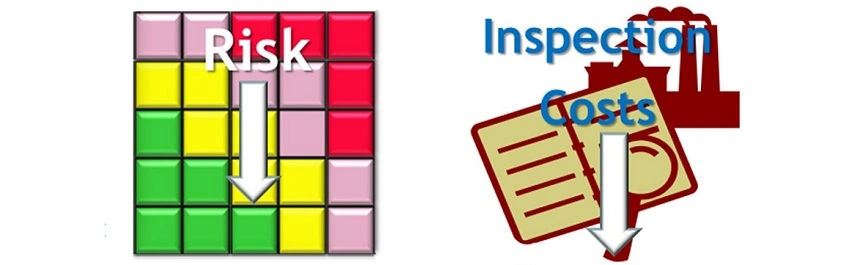
Similar to our two-day API 580 training, this one-day session is geared to help management and other stakeholders involved in an MI/RBI program gain insight into and understanding of what the essential elements are for Risk Based Inspection (RBI) as defined in API Recommended Practice 580. Additionally, the course focuses on the impact of RBI on the organization and the involvement required from management and other stakeholders.
Course Topics
- Introduction to API 580
- The RBI Team and Planning the RBI Assessment
- Identify Damage Mechanisms
- Determine Probability of Failure
- Determine Consequence of Failure
- Determine Risk and Communicate Risk Results
- Plan Mitigation Activities
Related Services
AOC has delivered thousands of sustainable Risk Based Inspection (RBI) programs earning the trust of owner operators.
When evaluation of inspection results suggest that an asset is near its end of useful life, Fitness for Service evaluations can determine if the asset us suitable for continued operation.
One of the most important steps in an RBI project is the corrosion study or damage mechanism review.
Related Tools
How well do you know RBI? Take this short quiz to test your knowledge of the API 580 risk-based inspection (RBI) work process.
Create mechanical integrity (MI) program value rather than it being seen as a necessary cost to minimize.
Is your plant's MI program compliant? Use our checklist to assess your current program against industry standards and receive expert recommendations for improvement.
Related Training
Is your Risk Based Inspection (RBI) program aligned with the API 580 Recommended Practice? Are you ready for certification?
What's actually going on inside all of that fancy software? An introduction to the API 581 methodology.
A deep dive into quantitative Risk Based Inspection (RBI) as outlined in API 581.
A high level overview introducing Mechanical Integrity and Risk Based Inspection
What are your goals for RBI? How will you measure your success? How will you sustain that success?
Related Knowledge
Practical guide for implementing a Mechanical Integrity and RBI program for U.S. oil and gas wellfield, gathering, and midstream facilities. Aligns lifecycle asset management, inspection, and risk control with API standards, PHMSA pipeline rules, and OSHA PSM requirements.
Organizations that follow the spirit of risk-based inspection rather than its minimum requirements use a definable, structured, auditable process to confirm that an alternate inspection technique provides equal or better risk reduction than a baseline method.
Safety-first organizations consistently outperform on reliability when priorities are truly enforced, not just stated.
Don’t let your RBI program become a "paperwork exercise." Learn how to distinguish between a qualified technical partner and a software-only contractor to ensure true operational safety.
Can Non-Intrusive Inspection (NII) finally replace vessel entries? Explore the roadblocks to RBI, validated POD data for UT and RT, and a new framework for technical equivalency in modern refinery maintenance.
Unified framework integrating MI, RCM, PHA, and SIL/SIS into one risk-based system using a common matrix, shared failure modes, and closed-loop feedback to align actions, prioritize resources, and ensure consistent, real-world risk reduction.
Risk Based inspection is not always cut and dry when it comes to choosing a methodology. Knowing which one to choose is an important step in the overall process.
What are equipment/inspection strategies in relation to mechanical integrity (MI) and risk based inspection (RBI)?
What are the requirements of API 580, 4th edition?
This is a practical approach to incorporating the new PHMSA gas well rules into your integrity program with the rest of your surface and subsurface assets.

Asset Optimization is the authority on asset integrity solutions that align your people, process, and technology with unmatched returns across your enterprise.
About AOC
Consulting Activities
Contact Us
United States
16000 Barkers Point LaneSuite 105
Houston, TX 77079
Phone: +1 (281) 909-7333
Email: info@aoccorp.com
Europe
CATCH Facility,Redwood Park Estate,
Stallingborough,
Grimsby, North East Lincolnshire,
DN41 8TH, United Kingdom
Phone: 00 44 (0) 1469 552875
Copyright © 2024 Asset Optimization Consultants, Inc. All Rights Reserved.
Course Inquiry
For more information about this course or to inquire about a customized version of this course hosted in-house at our Houston, Texas location or on-site at a location convenient to you, please complete the form below.