
Corrosion Control Planning
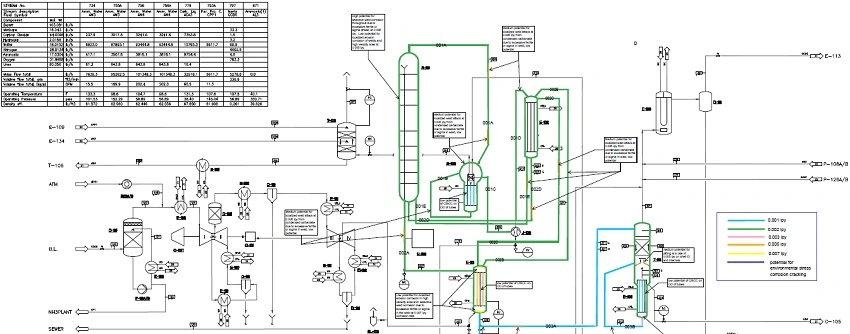
The corrosion plan identifies the locations for potential corrosion mechanisms along with recommendations for preventing corrosion damage from occurring in the process unit. Together with developing integrity operating windows, the corrosion control plan offers a comprehensive approach toward mitigating corrosion-related loss of primary containment in your industries. For example, Susceptible Locations for ESSCC Cracks include
...areas adjacent to penetrations in the insulation that are likely damage sites. Nozzles, Platform supports, Vacuum stiffening rings, piping support clamps are all susceptible locations for ESSCC cracks.
Weep holes in top head reinforcing pads can allow water and chlorides to get behind the repad and concentrate, allowing the cracking to progress undetected. Wax plugs, grease or short lengths of instrument tubing bent in a "goose neck" should be installed in the weep holes to prevent future water ingress. Similarly, ear type of lifting lugs can create a water trap. Since only the sides and bottom of the lug are welded, water can get behind the lug from the top head surface. Lugs should be removed after the vessel is installed.
In short, any locations of water ingress or collection points that can concentrate chlorides are a potential crack location.
An Update on Risk Based Inspection: Bringing Focus On External Corrosion Under Insulation, Stress Corrosion Cracking and Other Damage Mechanisms - NPRA Reliability and Maintenance Conference, 5/22/2012
Related Services
One of the most important steps in an RBI project is the corrosion study or damage mechanism review.
When evaluation of inspection results suggest that an asset is near its end of useful life, Fitness for Service evaluations can determine if the asset us suitable for continued operation.
AOC has delivered thousands of sustainable Risk Based Inspection (RBI) programs earning the trust of owner operators.
Related Tools
Create mechanical integrity (MI) program value rather than it being seen as a necessary cost to minimize.
How well do you know RBI? Take this short quiz to test your knowledge of the API 580 risk-based inspection (RBI) work process.
Is your plant's MI program compliant? Use our checklist to assess your current program against industry standards and receive expert recommendations for improvement.
Related Training
A high level overview introducing Mechanical Integrity and Risk Based Inspection
What are your goals for RBI? How will you measure your success? How will you sustain that success?
What impact does Risk Based Inspection (RBI) have on my organization?
Is your Risk Based Inspection (RBI) program aligned with the API 580 Recommended Practice? Are you ready for certification?
What's actually going on inside all of that fancy software? An introduction to the API 581 methodology.
Related Knowledge
MOC fails not from lack of knowledge, but from conflict with operational pressures. Speed is rewarded over rigor, definitions are unclear, ownership is weak, and risk reviews become procedural, allowing changes, cumulative risk, and hazards to go unmanaged.
Practical guide for implementing a Mechanical Integrity and RBI program for U.S. oil and gas wellfield, gathering, and midstream facilities. Aligns lifecycle asset management, inspection, and risk control with API standards, PHMSA pipeline rules, and OSHA PSM requirements.
Organizations that follow the spirit of risk-based inspection rather than its minimum requirements use a definable, structured, auditable process to confirm that an alternate inspection technique provides equal or better risk reduction than a baseline method.
Safety-first organizations consistently outperform on reliability when priorities are truly enforced, not just stated.
Don’t let your RBI program become a "paperwork exercise." Learn how to distinguish between a qualified technical partner and a software-only contractor to ensure true operational safety.
A globally standardized Loss of Containment Event Repository using validated data, controlled taxonomies, traceable evidence, and confidence scoring to improve RBI, mechanical integrity, process safety, and AI-driven failure prediction.
Can Non-Intrusive Inspection (NII) finally replace vessel entries? Explore the roadblocks to RBI, validated POD data for UT and RT, and a new framework for technical equivalency in modern refinery maintenance.
What are equipment/inspection strategies in relation to mechanical integrity (MI) and risk based inspection (RBI)?
This is a practical approach to incorporating the new PHMSA gas well rules into your integrity program with the rest of your surface and subsurface assets.
A targeted AI platform using a centralized repository of global loss-of-containment events to identify failure patterns, improve RBI predictions, strengthen mechanical integrity, and provide continuously updated, data-driven risk recommendations.

Asset Optimization is the authority on asset integrity solutions that align your people, process, and technology with unmatched returns across your enterprise.
About AOC
Consulting Activities
Contact Us
United States
16000 Barkers Point LaneSuite 105
Houston, TX 77079
Phone: +1 (281) 909-7333
Email: info@aoccorp.com
Europe
CATCH Facility,Redwood Park Estate,
Stallingborough,
Grimsby, North East Lincolnshire,
DN41 8TH, United Kingdom
Phone: 00 44 (0) 1469 552875
Copyright © 2024 Asset Optimization Consultants, Inc. All Rights Reserved.
Service Inquiry