
What Does "Good" Actually Look Like in Inspection?
by Michael Hurley, 1/14/2026 Be the first to commentTags: Damage Mechanisms Inspection Mechanical Integrity Probability
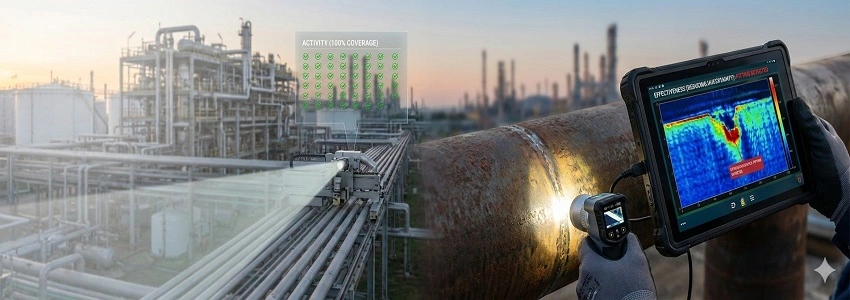
In mechanical integrity, we often confuse activity with assurance. A thick report or "100% coverage" means nothing if the inspection tool cannot "see" the damage morphology. This post explores what "good" inspection actually looks like by shifting the focus toward meaningfully reducing uncertainty. Learn the critical questions every program must answer and how to align NDE physics with specific damage mechanisms to prevent loss-of-containment events.
A friend of mine, a true gentleman and an experienced API inspector, posed a simple but powerful question on LinkedIn last week:
"What does good actually look like in inspection?"
The person who asked it was Paul Evey, and his post can be found here. It gets directly to the heart of why mechanical integrity (MI) continues to fail across refineries and process facilities.
As an engineer, my inspection friends will tell you that engineers have a tendency to over-analyze. In this case, I would argue that over-analysis is exactly what is required. Because "good inspection" is not intuitive, and it is certainly not defined by tradition, habit, or audit checklists.
What a Good Inspection is Not
A good inspection is not defined by:
- How many CMLs were taken
- How many scans were performed
- How thick the inspection report is
- How many boxes were checked
Those are measures of activity, not assurance.
A good inspection is defined by one thing:
Did we meaningfully reduce uncertainty about the damage mechanism?
If the answer is no, the inspection - no matter how expensive or comprehensive it looked - did not accomplish its purpose.
What a Good Inspection Must Answer
A good inspection program must be able to answer these questions:
| Question | What "Good" Looks Like |
|---|---|
| What can fail? | The damage mechanisms are correctly identified, localized, and bounded. |
| Where will it fail? | The highest-risk locations are known and actually examined. |
| Would we see it if it's there? | The inspection method has a demonstrated probability of detection (POD) for the relevant damage mechanisms (>= ~70%). |
| Does the report allow independent technical review? | The report contains enough information for a knowledgeable third party to evaluate what was examined and what could reasonably have been detected. |
At a minimum, the inspection report must include:
- A clear description of how much of the asset was examined
- Proper documentation of the inspection technique used, allowing it to be repeated
- A description of damage type, location, and dimensions
- An estimated or calculated damage rate
Without this information, the report may look professional, but it cannot be used to quantify inspection effectiveness.
What We Often Get Instead
In many facilities, inspection programs deliver:
- 100% scan coverage with a tool that cannot see the damage
- Spot UT where corrosion is highly localized
- Visual inspection where damage is subsurface
That produces confidence, not knowledge of the actual condition. Confidence, when it is unearned, can be deadly.
What "Good" Would Actually Look Like
A real inspection program would work like this:
Step 1 - Identify Damage Mechanism Morphology
Not just "corrosion," but:
- Pitting vs. general thinning
- Internal vs. external
- Under-deposit vs. flow-accelerated
- Wet H2S vs. amine vs. naphthenic vs. MIC
Each of these produces very different flaw shapes and very different inspection challenges.
Step 2 - Let Damage Morphology Drive NDE Physics
Inspection methods must be chosen based on what they can actually detect, not what is convenient or cheap:
- Shear-wave vs. straight-beam UT
- Guided-wave vs. conventional UT
- Digital radiography vs. film
- PEC vs. MFL vs. IRIS vs. ACFM
Physics matters. If the tool cannot "see" the flaw morphology, coverage is meaningless.
Step 3 - Prove Damage Mechanism Detectability
We must be able to answer:
- What size and type of indication is dangerous?
- What size and type can this method detect?
- What probability of detection has been demonstrated?
In reality, we often do not know these numbers and rely on engineering judgment. If that judgment is provided by inexperienced personnel, we are not estimating we are guessing.
Coverage is Not the Same as Detection
"Good" inspection is about reducing uncertainty, not about achieving coverage metrics. The biggest lie in modern inspection is:
"We had 100% coverage."
Coverage of what? With what sensitivity? For what damage mechanism? You can have 100% coverage and a 0% probability of detecting the flaw that will cause a loss of containment.
That is how HF leaks, exchanger ruptures, and refinery fires keep happening - even though "everything was inspected."
A Conversation the Industry Needs to Have
Paul Evey asked an important question. The industry needs to answer it honestly. If we truly want to prevent loss-of-containment events, we must stop mistaking inspection activity for inspection effectiveness and start demanding evidence that our programs actually reduce uncertainty about failure.
I invite the industry to have this conversation. What are your thoughts? Comment below, join the conversation on LinkedIn, or contact me directly. I am excited to hear your thoughts.
Add your comment
Related Services
When evaluation of inspection results suggest that an asset is near its end of useful life, Fitness for Service evaluations can determine if the asset us suitable for continued operation.
AOC has delivered thousands of sustainable Risk Based Inspection (RBI) programs earning the trust of owner operators.
A maintenance system designed in which elements work together as a quality system for maximum returns
Related Tools
Create mechanical integrity (MI) program value rather than it being seen as a necessary cost to minimize.
Is your plant's MI program compliant? Use our checklist to assess your current program against industry standards and receive expert recommendations for improvement.
Related Training
A high level overview introducing Mechanical Integrity and Risk Based Inspection
What impact does Risk Based Inspection (RBI) have on my organization?
Is your Risk Based Inspection (RBI) program aligned with the API 580 Recommended Practice? Are you ready for certification?
What's actually going on inside all of that fancy software? An introduction to the API 581 methodology.
A deep dive into quantitative Risk Based Inspection (RBI) as outlined in API 581.
Related Knowledge
A globally standardized Loss of Containment Event Repository using validated data, controlled taxonomies, traceable evidence, and confidence scoring to improve RBI, mechanical integrity, process safety, and AI-driven failure prediction.
Don’t let your RBI program become a "paperwork exercise." Learn how to distinguish between a qualified technical partner and a software-only contractor to ensure true operational safety.
Practical guide for implementing a Mechanical Integrity and RBI program for U.S. oil and gas wellfield, gathering, and midstream facilities. Aligns lifecycle asset management, inspection, and risk control with API standards, PHMSA pipeline rules, and OSHA PSM requirements.
Organizations that follow the spirit of risk-based inspection rather than its minimum requirements use a definable, structured, auditable process to confirm that an alternate inspection technique provides equal or better risk reduction than a baseline method.
Safety-first organizations consistently outperform on reliability when priorities are truly enforced, not just stated.
Can Non-Intrusive Inspection (NII) finally replace vessel entries? Explore the roadblocks to RBI, validated POD data for UT and RT, and a new framework for technical equivalency in modern refinery maintenance.
MOC fails not from lack of knowledge, but from conflict with operational pressures. Speed is rewarded over rigor, definitions are unclear, ownership is weak, and risk reviews become procedural, allowing changes, cumulative risk, and hazards to go unmanaged.
"Good inspection" is not defined by technical tools, but by a leadership choice to allow the truth about equipment condition to surface. Learn why management is the most critical variable in mechanical integrity.
This is a practical approach to incorporating the new PHMSA gas well rules into your integrity program with the rest of your surface and subsurface assets.
A targeted AI platform using a centralized repository of global loss-of-containment events to identify failure patterns, improve RBI predictions, strengthen mechanical integrity, and provide continuously updated, data-driven risk recommendations.
- 2018
- 2019
- 2020
- 2021
- 2024
- 2025
- 2026

Asset Optimization is the authority on asset integrity solutions that align your people, process, and technology with unmatched returns across your enterprise.
About AOC
Consulting Activities
Contact Us
United States
16000 Barkers Point LaneSuite 105
Houston, TX 77079
Phone: +1 (281) 909-7333
Email: info@aoccorp.com
Europe
CATCH Facility,Redwood Park Estate,
Stallingborough,
Grimsby, North East Lincolnshire,
DN41 8TH, United Kingdom
Phone: 00 44 (0) 1469 552875
Copyright © 2024 Asset Optimization Consultants, Inc. All Rights Reserved.
Comments
There are no comments for this article.