

Why Companies Prioritize Other PSM Elements Over Mechanical Integrity
by Michael Hurley, 12/10/2025 4 CommentsTags: Mechanical Integrity Process Safety Management Regulation
Mechanical Integrity (MI) is one of the most critical elements for preventing catastrophic events, yet it is routinely identified as one of the weakest in Process Safety Management (PSM). This article details 10 realistic reasons - from economic pressure and production bias to leadership knowledge gaps and the invisibility of degradation - why organizations chronically deprioritize MI work over other, more administrative PSM elements. Discover why companies focus on paper compliance instead of asset integrity.
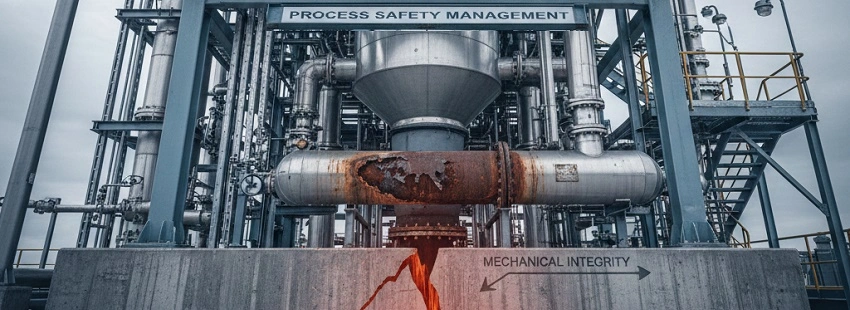
Mechanical Integrity is routinely identified by the CSB, OSHA, CCPS, and API as one of the weakest-performing PSM elements, even though it is one of the most critical for preventing catastrophic events.
The relevant question is, "Why do organizations deprioritize MI?" Organizations often say mechanical integrity (MI) is a priority, but in practice, it is one of the most commonly deprioritized elements of Process Safety Management. This happens for structural, cultural, and economic reasons. Here is our detailed, realistic explanation grounded in how refineries, chemical plants, and pipelines actually operate.
1. MI Costs Money, Interrupts Production, and Exposes Bad News
MI requires spending money now to prevent events that may not occur for years. MI is a pure cost center with no immediate financial return. It requires:
- NDT programs (UT, RT, PT, MT, phased-array)
- API-certified inspectors
- Metallurgical analysis
- Fitness-for-service (FFS) engineering
- Replacement of corroded or damaged equipment
- RBI software and digital tools
- Significant labor hours from operations, reliability, and maintenance
Unlike a project that increases throughput or reduces operating cost, MI spending has no visible "payback"; its benefit is avoiding future catastrophic failure, which is hard to quantify. This makes MI one of the first areas targeted during:
- Budget tightening
- Crude margin drops
- Capital discipline cycles
- Leadership turnover
As one refinery MI manager I spoke with said, "You don't get credit for the disaster you prevented." These things cost millions and directly compete with "uptime." The simple truth is that production pressure biases decisions, and the CSB repeatedly cites production pressure as a core root cause. For example, in the Chevron Richmond Refinery fire of 2012, it was found that Chevron repeatedly deferred replacing the corroded piping because the work would have required a shutdown.(1) In BP's Texas City Refinery explosion it was found that the refinery had a persistent emphasis on production over safety and deferred maintenance for budget reasons.(2)
Deferred MI work often appears "safe enough" until it catastrophically fails. Training, procedures, and documentation do not require shutting down units or spending capital. They create a visible sense of compliance without disrupting operations.
2. MI Findings Often Reveal Serious, High-Cost Problems
MI does something uncomfortable: it exposes risk, often in the form of:
- Large corrosion circuits needing replacement
- Blocked PSVs
- Pipe shoulders and elbows below minimum thickness
- Creep, HTHA, or sulfidation cracking
- Inadequate metallurgy
- Past-due inspections
This creates fear inside organizations because strong MI transparency can lead to:
- Large repair budgets
- Shutdowns or slowdowns
- Negative audit findings
- Capital project escalation
- Regulatory attention
- Executive scrutiny
- Difficult conversations with corporate
As CCPS notes, in their Guidelines for Risk-Based Process Safety, Mechanical integrity activities regularly uncover deficiencies requiring substantial resources to resolve, which may lead organizations to resist or delay action.(3)
In other words, MI produces bad news; paperwork does not. In weak safety cultures, some leaders subconsciously prefer not to know the true condition of their assets because knowing imposes:
- Responsibility
- Regulatory obligation
- Cost
- Operational disruption
How many times have you heard maintenance or production ask, "Are you sure we really need to look at that now?"
3. MI Requires Highly Specialized Knowledge That Leadership Often Lacks
Mechanical integrity (MI) is one of the most technically demanding parts of Process Safety Management. Unlike procedures, training, or incident investigations, which leaders generally understand, MI relies on complex engineering concepts that most non-technical managers, and even many engineers outside asset integrity, are not equipped to evaluate. This knowledge gap creates chronic underinvestment and misunderstanding of MI priorities. Below is a detailed breakdown of how the "expertise gap" affects organizational decisions:
MI involves specialized disciplines that most leaders have never practiced:
- API inspection codes (API 510, 570, 653)
- Damage Mechanism Reviews (DMRs)
- Risk-Based Inspection (RBI) modeling (API 580/581)
- Fitness-for-Service (FFS) evaluations (API 579)
- Metallurgy and material selection
- Creep, hydrogen damage, stress corrosion cracking
- Corrosion science and corrosion rate modeling
- Pressure relief system design (PSV sizing/calcs per API 520/521)
- Welding QA/QC, NDE interpretation
- Piping circuitization and corrosion loops
These are not concepts learned in typical engineering degrees or MBA programs. As a result, leaders are forced to rely on MI experts but often don't know enough to judge the quality of the advice. Executives can easily judge:
- Injury rates
- Training compliance
- MOC completion
- Procedure quality
But they cannot easily judge whether MI is healthy. They don't know how to evaluate:
- RBI logic quality
- Corrosion circuitization accuracy
- PSV sizing calculations
- NDE technique selection
- FFS assessments
- Thickness data reliability
- Inspection extent/coverage
- Damage mechanism assignment
This means MI can look "fine" on the surface even when the underlying program is deeply broken. Leadership may think MI is functioning well because:
- Reports are submitted
- Checkboxes are completed
- Software shows "green" boxes
- Inspectors generate paperwork
Meanwhile, equipment may be degrading unnoticed. This creates a dynamic where MI issues appear "too technical to argue with" yet simultaneously "too abstract to feel urgent." This creates a blind spot: MI problems continue for years without being fully recognized. Therefore, MI Becomes Invisible Until Failure Occurs. Mechanical integrity programs require specialized technical knowledge not widely held by all levels of management.(4)
4. MI Degradation Mechanisms Are Hidden, Unlike Most Other PSM Problems
Mechanical Integrity (MI) is uniquely challenging because most of the degradation that threatens process equipment happens out of sight inside vessels, inside piping, under insulation, or at welds that haven't been examined in years. Unlike procedural lapses or operational deviations, MI problems rarely announce themselves until late in their failure progression. This "invisibility" makes MI one of the most underrecognized and undervalued components of Process Safety Management.
Examples of hidden degradation:
- Internal corrosion under flowing corrosive fluids
- Creep at high temperature with no external indication
- Hydrogen blistering or HIC within the steel microstructure
- Sulfidation progressing beneath oxide layers
- Stress corrosion cracking at a weld toe
- CUI under insulation
- Random pitting inside exchangers or separator boots
- Erosion at the elbows that is not visible from the outside
Equipment can appear "normal" until it is minutes away from failure. Because people can't see it, MI rarely receives the same urgency as more visible hazards. Many damage mechanisms progress internally and are not evident without appropriate inspection techniques.(5)
On the contrary, most PSM issues are observable:
- A missing procedure is visible.
- A training gap is documented.
- A bypassed interlock alarm.
- A poor safety culture shows up in behavior.
Leadership doesn't typically identify these MI risks during normal operations, so other, more visible PSM elements receive more attention.
5. MI Requires Years to Build; Other PSM Elements Can Be "Completed" Quickly
One of the most overlooked reasons mechanical integrity (MI) consistently lags behind other Process Safety Management (PSM) elements is the massive difference in time horizon required to establish a functioning MI program. Unlike procedures, training, management of change (MOC), or even process hazard analysis (PHA) action closeout, tasks that can be completed in weeks or months, MI requires years of sustained effort before it becomes effective. This structural timeline mismatch makes MI harder to fund, harder to measure, and easier for organizations to defer.
Mechanical integrity is the opposite. MI requires infrastructure:
- Asset registry development
- Circuitization and corrosion loops
- Baseline inspection data
- NDE program buildout
- RBI model creation
- Metallurgy and materials reviews
- PSV relief system evaluations
- FFS methodologies
- Inspection planning and scheduling systems
- Competency and certification of personnel
An MI program cannot be built instantly because it relies on time-series data, including:
- Corrosion rate trends
- Repeated UT measurements
- Repair histories
- Exchanger bundle degradation patterns
- PSV performance data
- Inspection findings over multiple cycles
- Turnaround-specific inspection histories
This takes years, not months. Because leaders prefer initiatives with fast "wins", MI feels slow, heavy, and expensive. This creates a bias toward "fast compliance". The employer shall establish and implement written procedures to maintain the ongoing integrity of process equipment.(6)
"Ongoing" is the keyword. MI is continuous and lifelong.
6. MI Is Difficult to Audit. Paper PSM Is Easy to Audit
One of the most common and least discussed reasons organizations deprioritize Mechanical Integrity (MI) is that MI performance is hard to measure, hard to verify, and extremely hard to audit, especially compared to more administrative elements of Process Safety Management (PSM).
Most PSM elements can be evaluated by reviewing documents:
- Written procedures
- Training records
- MOC packages
- PHA worksheets
- Compliance audits
- Incident investigation reports
An external auditor or regulator can read a binder and check a box. But MI is grounded in the condition of actual equipment, not the documents describing that equipment. A refinery can have:
- Pristine MI procedures
- A complete inspection schedule
- "Green" KPI dashboards
- Audit reports showing "no findings"
and still have severe internal corrosion, eroded piping, fouled safety-critical valves, or failed tank bottoms.
MI doesn't fit neatly into compliance checklists. Regulators can easily audit:
- Written procedures? Yes/No
- Training records? Yes/No
- MOC forms? Yes/No
But MI compliance is inherently fuzzy:
- Is the corrosion rate correct?
- Is RBI adequate?
- Is inspection interval justified?
- Was the right NDE technique used?
- Is metallurgy appropriate for the service?
These cannot be answered with simple checkboxes. Therefore, organizations gravitate toward elements with clearer compliance boundaries. Unlike administrative PSM elements, mechanical integrity cannot be verified solely through documentation; the quality of engineering evaluations and inspections determines effectiveness.(7)
This means MI gets less audit scrutiny, reducing pressure to prioritize it.
7. Safety Culture Often Rewards the Appearance of Compliance, Not Actual Integrity
One of the most powerful reasons companies prioritize administrative PSM elements over Mechanical Integrity is that organizational safety culture frequently rewards the appearance of compliance rather than the reality of asset integrity. MI suffers more than any other PSM element under this dynamic.
Administrative PSM elements (PHA, MOC, training, procedures, audits) produce highly visible, easily measurable output. Leaders can see:
- Closed action items
- Updated procedures
- Completed training records
- Audit checklists with every box filled
These results create the impression of a strong safety program.
However, mechanical integrity does not produce "visible" compliance results. Compliance metrics favor paper PSM, not MI reality. Mechanical Integrity, by contrast, is extremely hard to quantify:
- "Percent of assets actually healthy" is not a standard KPI.
- Corrosion rates vary by location, temperature, flow regime, metallurgy, and contaminants.
- Visual inspection success rates cannot easily be captured in a metric.
- NDE quality varies widely, yet is almost invisible to leadership.
As a result, organizations drift toward compliant documentation rather than reliable equipment. An overreliance on written programs and administrative controls masked significant deficiencies in mechanical integrity.(8)
8. MI Failures Are Low-Frequency But High-Consequence, Which Encourages Complacency
Another structural reason organizations prioritize other PSM elements over Mechanical Integrity (MI) is that MI failures are rare, but when they occur, they are catastrophic. This low-frequency/high-consequence profile creates the perfect psychological and organizational conditions for complacency. The rarity of major MI failures creates a false sense of security. This rarity is deceptive. The longer a facility goes without a major MI-related accident, the more leadership begins to believe:
- "Our equipment is in good shape."
- "Our inspection program must be working."
- "The likelihood of a failure is low."
- "We can afford to defer this."
This dynamic allows MI budgets to be trimmed, inspections delayed, and corrosion concerns minimized, all without immediate consequences. Other PSM elements (training, procedures, audits, PHAs) receive more attention because their impact is visible every day, while MI risks stay hidden until a single, severe event exposes years of degradation.
Other contributing factors are:
- Human psychology underestimates or overestimates rare hazards with long latency.
- The absence of failures is mistaken for the presence of integrity.
- High-consequence MI events are so severe that sometimes leadership avoids analyzing them.
- Low-frequency events undermine the learning feedback loop for MI, making continuous improvement difficult.
Essentially, MI is ignored not because it is unimportant, but because it fails quietly until it fails catastrophically.
API 754 tells us many Tier 1 events originate from MI failures despite low frequency of exposure.(9) This is backed up by multiple CSB reports which indicate that normalization of deviance allows degradation mechanisms to continue unchecked because no failure had yet occurred.(10)
The low frequency reduces organizational vigilance even though MI failures are the primary triggers of catastrophic events.
9. Most PSM Elements Rely on MI, But Leadership Often Misses the Connection
Mechanical Integrity (MI) is the backbone of a safe process operation. Virtually every other element of Process Safety Management (PSM), such as PHA, MOC, procedures, training, audits, and emergency planning, depends on MI being effective. Yet, leadership often fails to recognize this dependency, which is another reason why MI is chronically deprioritized.
PSM elements depend on healthy equipment to function. Here are some examples:
- PHA (Process Hazard Analysis): Identifies hazards based on equipment condition, design, and past failure history.
- If MI is poor, the PHA assumptions about corrosion, erosion, fatigue, or valve reliability are invalid.
- Without accurate MI data, the hazard analysis may underestimate risk.
- MOC (Management of Change): Relies on current equipment health to assess new conditions or modifications.
- If MI is ignored, MOC reviews may approve changes on equipment that is already compromised.
- Procedures & SOPs: Operators follow steps assuming equipment is within design limits.
- Thinned vessels, eroded piping, or faulty relief systems can render even perfect procedures ineffective.
- Training: Focuses on safe operation under the assumption that equipment functions correctly.
- Without integrity assurance, operators may unknowingly work on unsafe equipment, undermining training effectiveness.
- Emergency Planning & Response: Assumes predictable equipment behavior during upset conditions.
- Poor MI can create failure scenarios that no emergency plan anticipates.
Leadership often evaluates PSM elements independently as separate silos:
- Are procedures updated?
- Are training records complete?
- Was MOC workflow followed?
- Were audits closed?
These silos show immediate, measurable progress.
However, MI is more abstract:
- Does a vessel actually have adequate wall thickness?
- Are relief valves sized correctly?
- Is piping still fit for service under current conditions?
Because MI operates behind the scenes, its critical role as the foundation of other PSM elements is often overlooked. CSB data shows that most major U.S. refinery accidents involve loss of containment, which is almost always an MI issue.
Most PSM elements are only as strong as the mechanical integrity of the assets they rely on. Leadership often misses this connection because:
- MI is technically complex
- MI work is invisible
- MI success prevents disasters rather than producing visible results
As a result, companies over-prioritize administratively visible PSM elements such as training, procedures, and audits, while the critical foundation of MI remains chronically underfunded and undervalued.
Therefore, MI is the foundation of all PSM, but its invisibility leads to systematic de-prioritization. Loss of containment events are most often the result of inadequate inspection, testing, repair, or replacement of critical equipment.(11)
10. MI Problems Accumulate Slowly While Documentation Problems Show Up Immediately
A key reason companies often prioritize other PSM elements over Mechanical Integrity (MI) is the difference in the visibility and timing of problems. MI issues develop gradually over time, while administrative or documentation deficiencies surface quickly, creating a perception that "paperwork problems are more urgent" and attracting disproportionate attention from leadership.
If you miss:
- PHA actions
- MOC approvals
- Operating procedure updates
- Training renewals
you get an immediate audit finding.
If you miss:
- A corrosion mechanism
- A thinning elbow
- A PSV rebuild interval
- A hydrogen-damaged circuit
the consequence might not appear for years.
The slow, invisible nature of MI degradation versus the immediate visibility of documentation deficiencies drives a systemic bias:
Fast, visible problems => prioritized
Slow, invisible, latent risks => deprioritized
This shaped the industry's behavior toward short-term compliance over long-term integrity.
Comprehensive Summary
Companies tend to prioritize other PSM elements over MI because MI is:
- The economic payoff is invisible and long-term.
- Production pressure dominates organizational culture.
- MI work is complex, technical, and easy to defer.
- Turnaround politics lead to deferred MI scope.
- MI degradation is slow and hidden.
- Specialized expertise is expensive and hard to maintain.
- Compliance pressure on MI is weaker than on other PSM elements.
Therefore, MI is essential - but invisible until it fails, which makes it chronically undervalued in organizations focused on short-term performance.
REFERENCES
- "Regulatory Report: Chevron Richmond Refinery Pipe Rupture and Fire", May, 2014, U.S. Chemical Safety and Hazard Investigation Board, https://www.csb.gov/assets/1/7/chevron_regulatory_report_05012014.pdf
- "Investigations with findings related to mechanical integrity and preventive maintenance", July, 2017, U.S. Chemical Safety and Hazard Investigation Board, https://www.csb.gov/recommendations/preventive-maintenance-investigations
- "Guidelines for Risk Based Process Safety", March 2007, Center for Chemical Process Safetyhttps://www.aiche.org/resources/publications/books/guidelines-risk-based-process-safety
- "Guidelines for Risk Based Process Safety", March 2007, Center for Chemical Process Safetyhttps://www.aiche.org/resources/publications/books/guidelines-risk-based-process-safety
- "API RP 571: Damage Mechanisms Affecting Fixed Equipment in the Refining Industry", March, 2020, American Petroleum Institute, https://www.api.org/products-and-services/standards/important-standards-announcements/recommendedpractice571
- "1910.119 Process safety management of highly hazardous chemicals", Occupational Safety and Health Administration, https://www.osha.gov/laws-regs/regulations/standardnumber/1910/1910.119
- "Guidelines for Mechanical Integrity Systems", April 2017, Center for Chemical Process Safety, https://www.wiley.com/en-ie/Guidelines+for+Mechanical+Integrity+Systems-p-9781118216224
- "CSB investigations involving inadequate mechanical integrity programs", U.S. Chemical Safety and Hazard Investigation Board, https://www.csb.gov/recommendations/csb-investigations-mechanical-integrity
- "API RP 754: PRocess Safety Performance Indicators for the Refining and Petrochemical Industries", August, 2021, American Petroleum Institute, https://www.api.org/products-and-services/standards/important-standards-announcements/754 (https://www.api.org/products-and-services/standards/important-standards-announcements/754)
- "Investigations, U.S. Chemical Safety and Hazard Investigation Board, https://www.csb.gov/investigations/ (https://www.csb.gov/investigations/)
- "Process Safety at a Glance", Center for Chemical Process Safety, https://www.aiche.org/sites/default/files/docs/pages/ccps_at_glance_2021.pdf
Add your comment
Related Services
Key parameters and mitigating actions for variables that may dramatically affect the intended design life of your asset
A maintenance system designed in which elements work together as a quality system for maximum returns
AOC delivers the policies, procedures, work processes, knowledge and actions such as preventive maintenance, predictive maintenance, and condition monitoring tasks.
Related Tools
Is your plant's MI program compliant? Use our checklist to assess your current program against industry standards and receive expert recommendations for improvement.
Create mechanical integrity (MI) program value rather than it being seen as a necessary cost to minimize.
Related Training
A high level overview introducing Mechanical Integrity and Risk Based Inspection
What impact does Risk Based Inspection (RBI) have on my organization?
Is your Risk Based Inspection (RBI) program aligned with the API 580 Recommended Practice? Are you ready for certification?
What's actually going on inside all of that fancy software? An introduction to the API 581 methodology.
A deep dive into quantitative Risk Based Inspection (RBI) as outlined in API 581.
Related Knowledge
A formal acceptable risk policy standardizes risk tolerance, assigns decision authority by risk level, and requires escalating approvals for higher risk, improving consistency, transparency, and resource prioritization while preventing unmanaged risk exposure.
Unified framework integrating MI, RCM, PHA, and SIL/SIS into one risk-based system using a common matrix, shared failure modes, and closed-loop feedback to align actions, prioritize resources, and ensure consistent, real-world risk reduction.
MOC fails not from lack of knowledge, but from conflict with operational pressures. Speed is rewarded over rigor, definitions are unclear, ownership is weak, and risk reviews become procedural, allowing changes, cumulative risk, and hazards to go unmanaged.
Practical guide for implementing a Mechanical Integrity and RBI program for U.S. oil and gas wellfield, gathering, and midstream facilities. Aligns lifecycle asset management, inspection, and risk control with API standards, PHMSA pipeline rules, and OSHA PSM requirements.
Organizations that follow the spirit of risk-based inspection rather than its minimum requirements use a definable, structured, auditable process to confirm that an alternate inspection technique provides equal or better risk reduction than a baseline method.
The U.S. refining industry recorded nine significant fires and explosions in 2025. While the count is low, incidents at Chevron and HF Sinclair highlight the critical need for robust mechanical integrity and process safety programs.
Discover why equipment failure is the root cause of most catastrophic incidents. Mechanical Integrity (MI) is the non-negotiable foundation that prevents loss of containment and protects your entire PSM system. Learn the 8 reasons MI is essential.
PHMSA vs. OSHA: Understanding the Overlap Hydrocarbon facilities like pipelines, refineries, and terminals often fall under both PHMSA (DOT) and OSHA (DOL). Learn where each agency's jurisdiction begins and ends, and how to coordinate your integrity programs for compliance.
This is a practical approach to incorporating the new PHMSA gas well rules into your integrity program with the rest of your surface and subsurface assets.
Safety-first organizations consistently outperform on reliability when priorities are truly enforced, not just stated.
- 2018
- 2019
- 2020
- 2021
- 2024
- 2025
- 2026

Asset Optimization is the authority on asset integrity solutions that align your people, process, and technology with unmatched returns across your enterprise.
About AOC
Consulting Activities
Contact Us
United States
16000 Barkers Point LaneSuite 105
Houston, TX 77079
Phone: +1 (281) 909-7333
Email: info@aoccorp.com
Europe
CATCH Facility,Redwood Park Estate,
Stallingborough,
Grimsby, North East Lincolnshire,
DN41 8TH, United Kingdom
Phone: 00 44 (0) 1469 552875
Copyright © 2024 Asset Optimization Consultants, Inc. All Rights Reserved.
Comments